Chronic problems don't start overnight. They don't restore overnight either.
Whole-Body Health Plan for Chronic & Complex Conditions
If you've been dealing with a health problem for months or years, it is often no longer just one symptom. By the time a condition becomes chronic, recurring or complex, sleep, digestion, circulation, immune regulation, stress response, energy, pain and other functions may have begun affecting one another. That is why meaningful restoration usually takes more than a few treatments.
An early response can be encouraging. But an early response is not the same as restoration. For chronic and complex conditions, meaningful recovery needs enough time and continuity for the whole system to regulate, rebuild and become more stable.

Your body is one system
Your symptoms feel separate. Your body is not.
Almost everyone comes in focused on one main concern, and mentions the rest — if at all — as unrelated:
-
"I'm here for the migraines. I also don't sleep well, but that's just stress."
-
"It's my blood pressure. My stomach's always been like that."
-
"The joint pain. And my hands are always cold, but everyone says that."
These symptoms may look unrelated, but they can be connected by the same underlying patterns. Poor sleep, digestive changes, cold hands, anxiety, fatigue, pain or headaches may be different expressions of changes affecting the body as a whole.
Treating only the symptom that bothers you most, while leaving the rest alone, can give relief without changing the condition underneath.

We don't just follow the six symptoms separately. We look at how the whole system is functioning.
A common question
"Will I feel better after one visit?"
You may. Some patients notice a change after the first treatment — better sleep that night, a looser neck, a quieter stomach. Others need more time before the body begins to respond clearly. Both are normal.
But whether you feel something immediately is not the most important question.
Many people come to us after living with a condition for years. They may have seen several doctors and tried medications, therapies, dietary changes and other approaches. After a health journey that long, it's understandable to hope that something different will work quickly.
But a condition that has developed and persisted for years should not be judged by what happens in one or two treatments.
The first question is not "Am I cured?"
It is "Is my body beginning to respond?"
Think of your body like a city
Fixing one intersection does not restore the city.
If one road is blocked, clearing it may solve a local problem. But when the whole city has been struggling for years, fixing one intersection does not restore how the entire city functions.
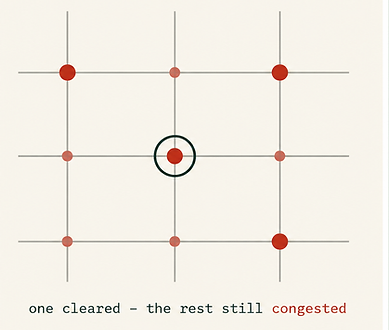
Treat one symptom
One intersection improves
One symptom gets better for a while. The rest of the system is still congested, so the problem tends to come back — the conditions around it haven't changed.

Restore the whole system
The whole city begins to work better
Flow and coordination improve across the whole system, not only where it hurts most. Improvement has somewhere to hold.
The goal is not simply to clear the intersection that hurts the most. The goal is to help the whole city function better.
Why it takes time
Restoration happens in layers
Chronic conditions develop through repeated patterns over years. Restoration also happens over time — and what matters is not just whether you feel different after a treatment, but whether the body begins to hold those changes.
01 The body responds
Early treatment creates the first meaningful shift — in pain, sleep, digestion, energy or another area. That response tells us how your system is functioning.
02 The improvement holds
Feeling better for a day is different from becoming stable. The next job is helping the body keep the change rather than slide back.
03 Deeper patterns change
As one area settles, the imbalance underneath it becomes clearer and can be addressed. Care moves to the next layer instead of repeating the same thing.
04 The whole body stabilizes
Improvement increasingly carries into daily life between visits — with less and less outside support.
Think in months — not visits.
Feeling better is the beginning. Becoming stable is the goal. For chronic and complex conditions, meaningful change is measured over months, not by the number of appointments.
That is why chronic care usually needs continuity — not simply a series of disconnected appointments. With continuity, each treatment builds on how your body responded to the last one, and care can change as your body changes. What that looks like for you is decided after Dr. Joy has seen you, not before.
How do we know it's working?
We follow the whole body, not one symptom.
Continuous care gives enough time to follow not only the symptom that brought you in, but whether sleep, digestion, energy, circulation, stress response, pain and resilience are changing together — and to adjust care as the answers change. Those months are not spent waiting.
After the first visits
Over the next weeks
Over the months
Look for response
-
Did something begin to shift — sleep, pain, digestion, temperature, mood?
-
A small change in an "unrelated" area counts.
Look for stability
-
Is improvement lasting longer between visits?
-
Are symptoms returning less often?
Look for broader change
-
Is sleep steadier, digestion quieter, energy more even?
-
Is the body less reactive — to food, weather, stress?
-
Are different areas improving together?
These changes may seem unrelated. But when several areas begin improving together, they can be signs that the body as a whole is functioning better.
Where it starts
One to three visits. Then you decide.
You don't need to decide anything before you come in. Dr. Joy will first evaluate your overall health, begin treatment, and see how your body responds.
Not every patient needs structured, continuous care. If your concern is relatively localized, individual visits may be enough, and she'll say so. If it appears chronic, complex or system-wide, she'll explain why a more structured approach may be appropriate — after the initial visits, once she has enough clinical information.
01 Tell the whole story
Not only the main symptom. Sleep, appetite, digestion, bowel habits, energy, temperature, stress, mood — the "unrelated" changes all matter.
02 Whole-person assessment
Pulse, tongue and hands-on examination. She looks for the patterns that may connect different parts of your health.
03 First treatment
Treatment begins during the same visit, based on the priorities identified in your evaluation.
04 A recommendation based on what she finds
Whether your concern appears relatively localized, or whether a more structured restoration process may be appropriate. You decide from there.
A full clinical evaluation with treatment